
Bitcoin has been at the centre of the cryptocurrency industry since its creation and remains the digital asset that defines the market for millions of people around the world. In short, Bitcoin is King. Introduced as a peer-to-peer electronic cash system, Bitcoin established a new way to transfer and hold value without relying on a central bank or financial institution to operate the network. Revolutionary would be an understatement.
For Canadians, Bitcoin has also become one of the most recognizable ways to enter the cryptocurrency market. Some people buy Bitcoin as a long-term investment, others use BTC to diversify or spread out their holdings, and, well, some simply want direct ownership of the #1 ranking digital asset with a limited supply and a rock solid network that operates around the clock.
At MyBTC.ca, Canadians buy and sell Bitcoin using Canadian dollars and familiar payment methods. This guide explores Bitcoin’s history, how the Bitcoin network works, why BTC remains the benchmark cryptocurrency, how to buy Bitcoin in Canada and how to securely store your coins after purchasing them.
What Is Bitcoin (BTC)?
Bitcoin is a decentralized digital currency that allows value to be transferred directly between participants across a global peer-to-peer network.
Unlike Canadian dollars, Bitcoin is not issued by a government or central bank. Transactions are recorded on the Bitcoin blockchain, a public distributed ledger maintained by thousands of independent participants around the world.
BTC is the native currency of the Bitcoin network.
One of Bitcoin’s defining characteristics is scarcity. The Bitcoin protocol limits the total supply to 21 million BTC. New bitcoins enter circulation through mining, with the rate of new issuance periodically reduced through events known as Bitcoin halvings.
This predetermined monetary structure separates Bitcoin from fiat currencies whose supply can be expanded by central banks.
Bitcoin is also divisible. You do not need to purchase one entire BTC. A single bitcoin can be divided into 100 million smaller units known as satoshis, making it possible to purchase an amount that fits your budget.

The History of Bitcoin
Bitcoin emerged during one of the most turbulent periods in modern financial history. Remember the subprime mortgage meltdown? Yes, that one.
On October 31, 2008, an individual or group using the pseudonym Satoshi Nakamoto published the Bitcoin white paper titled Bitcoin: A Peer-to-Peer Electronic Cash System. The document proposed a method for making electronic payments directly between parties without requiring a trusted financial intermediary.
The Bitcoin network officially launched in January 2009 when Nakamoto mined its first block, known as the Genesis Block.
Bitcoin combined several technologies that had existed previously, including cryptography, peer-to-peer networking and proof-of-work, into a functioning decentralized monetary network.
The breakthrough was Bitcoin’s solution to the double-spending problem. Digital information can normally be copied easily. Bitcoin created a system in which network participants could agree on transaction history without a central authority maintaining the ledger.
From those beginnings, Bitcoin grew from an experimental open-source project into the top cryptocurrency recognized around the world.
How Does the Bitcoin Network Work?
When someone sends Bitcoin, the transaction is broadcast to the Bitcoin network.
Bitcoin miners collect transactions and compete to add new blocks of transactions to the blockchain through a process called Proof of Work.
Mining requires specialized computing equipment to perform enormous numbers of calculations. The miner that successfully solves the required computational challenge can propose the next block and receive a block reward along with applicable transaction fees.
Once transactions have been included in blocks and additional blocks are added afterward, reversing them becomes increasingly difficult.
This combination of cryptography, economic incentives, computing power and decentralized participation provides the foundation for Bitcoin network security.
No single company operates Bitcoin. The rules of the network are enforced collectively by its software, miners, nodes and users.
Why Bitcoin Remains the Benchmark Cryptocurrency
Thousands of cryptocurrencies have been created since Bitcoin launched, but BTC continues to occupy a unique position in the digital asset market.
1. Limited Supply
Bitcoin has a maximum supply of 21 million BTC. Its issuance schedule is built directly into the protocol, creating a transparent and predictable supply structure. This scarcity contrasts with fiat currencies, whose supply can be expanded through monetary policy. Because some Bitcoin may also become permanently inaccessible when private keys are lost, its effectively available supply can decrease over time, reinforcing Bitcoin’s scarcity-based monetary design.
2. Decentralization
Bitcoin does not have a CEO, corporate headquarters or central organization capable of unilaterally changing the network.
Independent nodes located around the world verify transactions and enforce Bitcoin’s consensus rules.
3. Network Security
Bitcoin’s Proof-of-Work mining network commits substantial computing resources to securing the blockchain. Attempting to rewrite confirmed transaction history becomes increasingly difficult as additional blocks are produced.
4. Global Recognition
BTC is recognized around the world and has developed deep global liquidity, extensive infrastructure and widespread support across cryptocurrency wallets and services.
5. Long Operating History
Bitcoin has operated continuously since 2009. That history distinguishes it from newer digital assets and provides investors with a much longer record to evaluate.
For many Canadians, Bitcoin is therefore the first cryptocurrency they research when considering digital asset ownership.
How to Buy Bitcoin in Canada
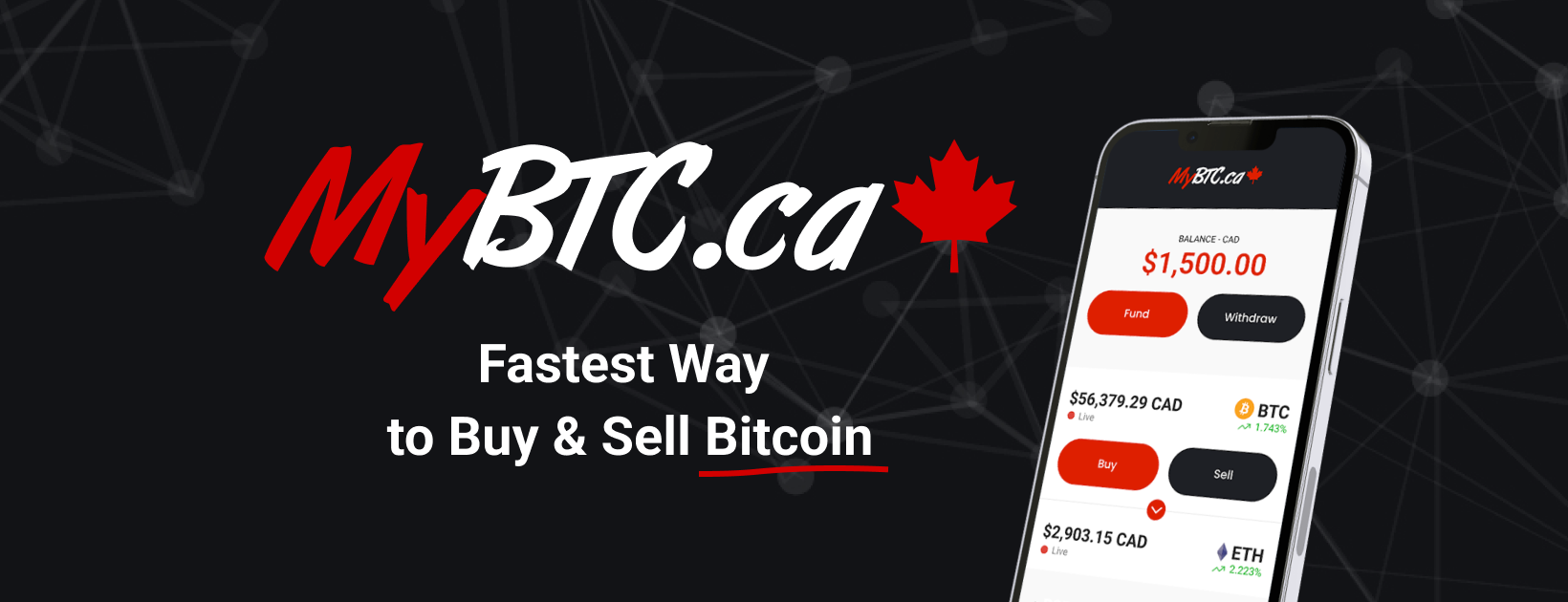
Buying Bitcoin through MyBTC.ca can be completed online using Canadian dollars.
Step 1: Create Your MyBTC.ca Account
Begin by creating your free MyBTC.ca account or signing in if you already have one.
You will need to provide the required account information and complete identity verification before accessing supported funding options.
Identity verification is a standard component of Canada’s cryptocurrency compliance framework and helps protect both customers and financial platforms.
Step 2: Choose How You Want to Fund Your Purchase and Add Money
Once your account has been verified, select the Canadian payment method that works best for your transaction.
MyBTC.ca supports several funding options, including:
- Interac e-Transfer
- Online Bill Payment
- Bank Wire Transfer
- Apple Pay
- Google Pay
- Flexepin vouchers
- Credit or debit card
Interac e-Transfer is a popular option for Canadians because it allows CAD to be sent directly through familiar online or mobile banking.
Customers making larger Bitcoin purchases may prefer Bill Payment or Bank Wire depending on their transaction size and funding requirements.
Always review current funding limits, processing times and applicable fees before initiating your transaction.
Once you have added CAD to your MyBTC.ca account balance, you can then buy Bitcoin in Canada instantly.
Step 3: Obtain Your Bitcoin Wallet Address
MyBTC.ca operates using a non-custodial model, which means you provide the Bitcoin wallet address where you want your BTC delivered.
Before submitting an order, carefully verify the destination wallet address. Make sure to use the copy and paste clipboard provided so there’s no entry errors or spaces.
Bitcoin transactions cannot simply be reversed after they have been broadcast and confirmed on the blockchain. Sending BTC to an incorrect or incompatible address can result in permanent loss.
Step 4: Create and Complete Your Bitcoin Order
After your Canadian dollar funding has been received and your account balance is available, you can create your Bitcoin order.
Enter the amount you want to purchase, select the BTC cryptocurrency option, enter the destination BTC wallet address and view the transaction details. Now complete the order.
Your purchased BTC is then sent to the Bitcoin wallet address you provided and will become spendable once confirmed on the blockchain.
Can You Buy a Fraction of a Bitcoin?
Great question. Yes, you most certainly can!
The price of one Bitcoin does not determine the minimum amount you need to own.
Bitcoin is divisible to eight decimal places, with the smallest unit being the satoshi. There are 100,000,000 satoshis in one BTC.
This allows Canadians to purchase Bitcoin based on a Canadian dollar amount instead of buying an entire coin.
If you want to buy $100, $500, $1,000 or another amount of Bitcoin, you can use the live MyBTC.ca calculator to see how much BTC your Canadian dollars can purchase based on current pricing.
Choosing a Bitcoin Wallet
Buying Bitcoin and securely storing Bitcoin are two separate parts of cryptocurrency ownership.
A Bitcoin wallet allows you to manage the cryptographic keys associated with your BTC.
Software Wallets
Software wallets can be installed on a computer or mobile device and are often convenient for people who regularly access or transact with their Bitcoin.
Because these wallets may remain connected to the internet, strong passwords, secure backups and multi-factor authentication should be used whenever available.
Hardware Wallets
Hardware wallets are physical devices designed to keep private keys separated from internet-connected devices.
Many long-term Bitcoin holders prefer hardware wallets because they provide an additional layer of protection against online threats.
Regardless of which wallet you choose, securely record your recovery phrase and store it somewhere private. Anyone who obtains your recovery phrase may be able to access your Bitcoin.
Never share it with another person. Ever.
What Is Bitcoin Mining?
Bitcoin mining performs two important functions: it helps secure the network and provides the mechanism through which new BTC enters circulation.
Miners use specialized computers to compete in Bitcoin’s Proof-of-Work process.
A successful miner can add a new block to the blockchain and receive a reward consisting of newly issued Bitcoin and transaction fees.
Bitcoin’s issuance rate decreases approximately every four years through a halving. During a halving (or sometimes referred to as the halvening), the block subsidy paid to miners is reduced by half.
This process will continue until Bitcoin approaches its maximum supply of 21 million coins.
How to Sell Bitcoin in Canada
Bitcoin ownership does not have to end with holding BTC indefinitely.
When you’re ready to convert Bitcoin back into Canadian dollars, MyBTC.ca allows customers to sell BTC through its online platform.
You send Bitcoin to the designated receiving address provided for your transaction. Once the required 2 blockchain confirmations process has been completed, the Bitcoin will be converted into CAD automatically at the current live rate.
Canadian dollar proceeds can then be withdrawn using supported payout methods such as Interac e-Transfer (most popular) and Bank Transfer (better for large amounts).
Always confirm the receiving address and transaction information before sending Bitcoin.
Bitcoin and Taxes in Canada
Whatever your opinion is about taxation in Canada, taxes are a reality crypto enthusiasts need to be aware of when trading. Buying and simply holding Bitcoin does not automatically create a taxable event, but certain transactions involving BTC can have Canadian tax implications.
Selling Bitcoin, trading it for another cryptocurrency, using BTC to purchase goods or services, or otherwise disposing of it may result in a capital gain, capital loss, business income or business loss depending on your individual circumstances.
For that reason, Canadians who purchase Bitcoin should maintain accurate records of their transactions, including purchase dates, Canadian dollar values, quantities and dispositions.
Tax treatment depends on individual circumstances, so consult current Canada Revenue Agency guidance or a qualified Canadian tax professional when necessary.
Buy and Sell Bitcoin with Canadian Support
Bitcoin may operate globally, but buying it in Canada does not mean you have to navigate the process without local assistance.
MyBTC.ca has helped Canadians access Bitcoin since 2016 and provides a non-custodial purchasing experience built around Canadian payment methods.
Customers can fund purchases using options such as Interac e-Transfer, Bill Payment, Bank Wire, Flexepin and supported cards, while purchased Bitcoin is delivered to the wallet address selected by the customer.
If you have questions about verification, funding, wallets or completing a transaction, our real human local Canadian support team is available by phone, text and email.
Final Notes of Conclusion
More than a decade and a half after the Bitcoin network produced its first block, BTC remains the reference point for the cryptocurrency market.
Its influence comes from more than price. Bitcoin introduced a working model for decentralized digital scarcity, demonstrated how value could be transferred across a peer-to-peer network without a central operator and established a monetary system governed by transparent rules rather than discretionary issuance.
Its 21 million BTC supply limit, Proof-of-Work security, global network of independent participants and long operating history have helped Bitcoin maintain a position unlike any other cryptocurrency.
For Canadians interested in owning BTC directly, the process remains simplistic. MyBTC.ca provides access to Bitcoin using Canadian dollars, familiar funding methods, direct delivery to your personal wallet and Canadian real human support when you need it.
Add the enduring mystery of Satoshi Nakamoto’s identity, and Bitcoin becomes an even more remarkable story, one that continues to unfold before our eyes in real time.