

Bitcoin Inheritance Canada: Protect Your Crypto
Introduction
Navigating the intersection of decentralized finance and traditional Canadian law is one of the most critical challenges for modern investors. For many, Bitcoin is more than a speculative asset; it is a store of value that requires sophisticated Estate Planning. The primary challenge lies in the "Private Key Paradox": if your heirs cannot access your private keys, your Digital Assets are effectively lost to the blockchain forever. In Canada, failing to plan doesn't just put your wealth at risk, it triggers complex legal and tax hurdles that can burden your survivors. This guide bridges the gap between the technical requirements of self-custody and the regulatory framework of the Canada Revenue Agency.
Your Recovery Phrase Is the Key
The bedrock of your security is your seed phrase (or recovery phrase). This sequence of 12 to 24 words acts as the master key to your hardware wallet. Because blockchain transactions are irreversible, losing this phrase is equivalent to losing the assets themselves. When considering inheritance, you must balance security with accessibility. A hardware wallet kept in Cold Storage is excellent for protection, but if that device is locked away without a clear, documented path for your executor, you have inadvertently created an impossible hurdle. Ensure that your seed phrase is stored in a physically secure location, such as a fireproof safe, but remember that the "where" is just as important as the "how." Providing your executor with clear instructions on how to locate and use these credentials is the most vital step in your Digital Assets protection strategy.
Bitcoin has a well-known saying: “Not your keys, not your coins.” The phrase reminds investors that true ownership comes from controlling your own private keys, not leaving your cryptocurrency on an exchange or with another party. Self-custody gives you complete control over your Bitcoin and Ethereum, but it also means you’re responsible for making sure your beneficiaries can recover those assets if you’re no longer able to.
Using a Multisignature Wallet for Bitcoin Inheritance
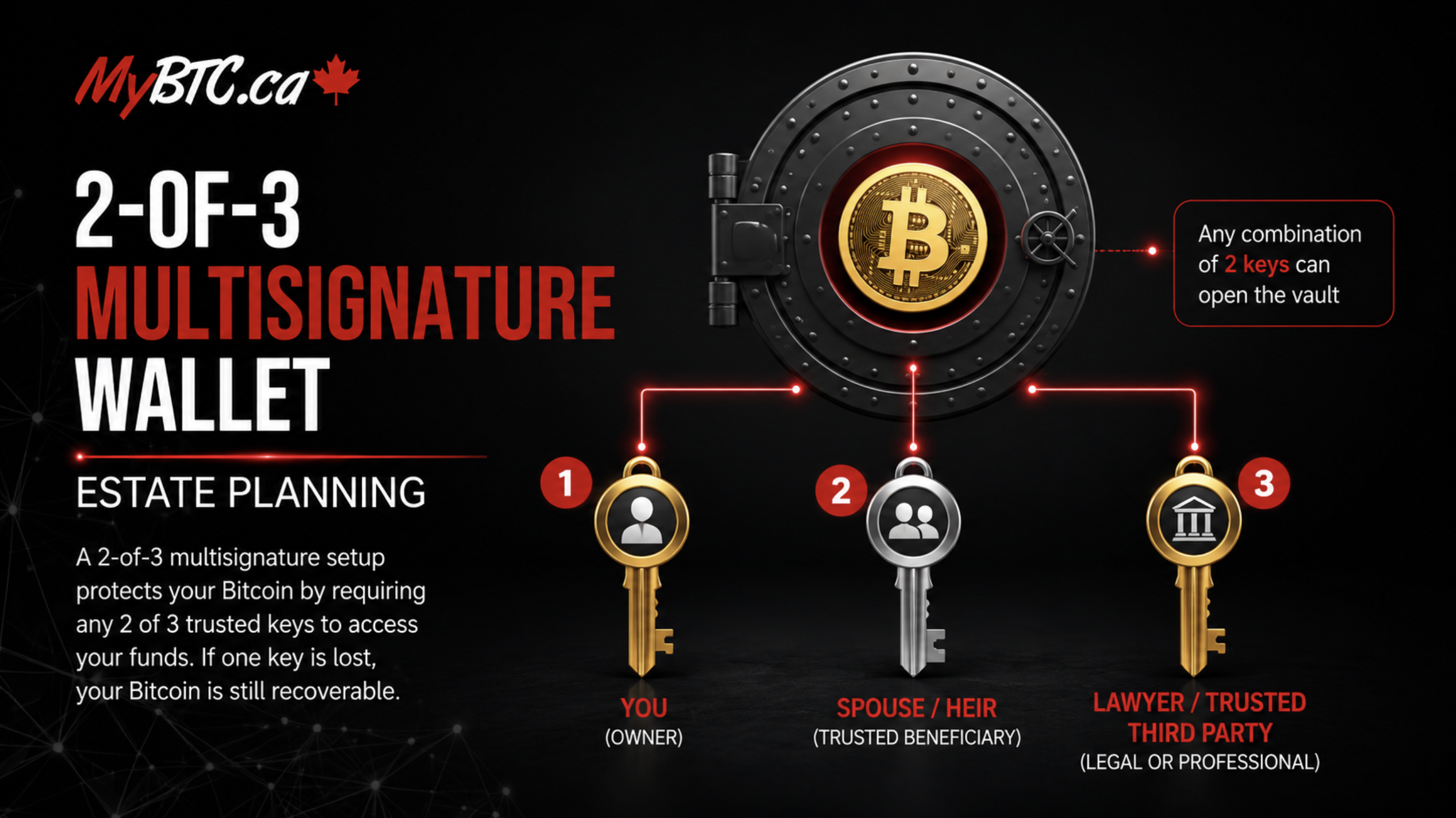
A 2-of-3 multisignature setup distributes risk by requiring multiple parties to authorize a transaction, ensuring heirs can access funds even if one key is lost.
To mitigate the "single point of failure" risk, many advanced investors utilize multisignature (multi-sig) wallets. A multi-sig setup requires a predefined number of keys to authorize a transaction, for instance, a two-of-three configuration. This is a game-changer for Estate Planning. You might hold one key, your common-law partner or spouse holds a second, and a trusted third party or legal professional holds the third. In the event of your death, the remaining keys can be used to recover the funds, ensuring that your crypto assets are not locked away by a single lost device. This structure provides a layer of redundancy that is far superior to relying on a single paper backup.
Can Bitcoin Be Released After a Certain Time?
Technically, Bitcoin's protocol allows for "timelocks" using script-based functions. These allow you to set specific conditions under which funds become spendable. While these features are powerful, they require significant technical expertise. A "Dead Man's Switch" can be simulated through various smart contract platforms or multisig configurations, where a transaction is programmed to trigger if a specific "check-in" doesn't occur. For most Canadians, these solutions should be viewed as advanced tools. Relying on complex code for your primary inheritance strategy is risky; instead, use these as secondary layers alongside a robust, legally drafted Will that explicitly mentions your crypto assets.
Planning for Incapacity, Not Just Death
Estate planning is not merely about the final transfer of wealth; it is about continuity during periods of incapacity. If you suffer a medical emergency, your family may need to manage your finances. Without a valid Power of Attorney that specifically addresses Digital Assets, your representatives may find themselves legally unable to access your crypto assets. You must ensure your legal documents explicitly grant your attorney the authority to manage and dispose of your digital holdings. Failing to do so can lead to a state of paralysis where your assets are "trapped" in your account, inaccessible to those who need them to fund your care.
Kidnapping, Coercion and Physical Security
In the world of Bitcoin, privacy is security. If your holdings are widely known, you become a target for coercion. Never store your entire net worth in a single, easily accessible location. By distributing your keys across various Cold Storage devices and using multi-sig arrangements, you ensure that no single person, or attacker, can unilaterally seize your wealth. Your inheritance plan should remain confidential, known only to those you trust implicitly. Avoid public discussion of your balances or storage setups. A quiet, secure, and well-documented plan is the best defense against both physical threats and the risk of accidental loss.
Remember the Canadian Tax and Estate Impact
In Canada, Bitcoin is classified as capital property. Under the Income Tax Act, your death triggers a deemed disposition of your assets at fair market value immediately before death. This means your estate must calculate the capital gain (or loss) by subtracting the Adjusted Cost Base from the fair market value at the time of death.
- Tax Filing: 50% of the capital gain is taxable and must be reported on your final tax return.
- Tax Obligations: Even if the Bitcoin is not sold, the Canada Revenue Agency treats the transfer to your heirs as a taxable event.
- Strategic Deferral: Consider utilizing a spousal trust or transferring assets to a common-law partner to defer immediate tax implications.
- Valuing Crypto-assets: You must maintain meticulous records of your cost basis to ensure accurate tax filing and avoid potential CRA tax reassessments.
Failure to properly account for these tax purposes can lead to significant interest and penalties, turning a well-intentioned inheritance into a financial burden for your beneficiaries.

Build the Plan Before It Is Needed
The transition of digital wealth requires a holistic approach. It is not enough to simply hand over a password; you must create a comprehensive "digital asset memorandum" that outlines the location of your keys, the nature of your wallets, and the tax implications for your executor. Work with Canadian crypto tax lawyers to ensure that your will reflects current estate tax norms and that your estate planning accounts for the volatility and unique nature of capital assets.
Start by organizing your Adjusted Cost Base records today. Ensure your executor is legally empowered, technically prepared, and fully aware of the Income Tax Act requirements. By integrating your technical hardware wallet management with robust, compliant legal frameworks, you ensure that your legacy remains a gift, not a liability, for the ones you leave behind.



I Want My Bitcoin!
Click a payment method to start your order.

Interac e-Transfer

Bank Wire

Credit or Debit Card

Flexepin Voucher